
Together with LIME and LIME Interim, we are the sparring partner for CFOs and for financial management of organisations in the commercial business sector. As LEMON, we advise on and connect them to the best talent in finance. In addition, we advise on team structure and talent management; identifying, developing and engaging future leaders.
This way we help organisations attract talented financials who are driven to push themselves. Who develop into your future leaders, strive for continuous optimisation and add value across all levels of the organisation.
Our network consists of ambitious financials who are ready for a challenging second or third step in their career. The salary range in which we act ranges from approx. €70k to €100k base salary. This could include positions such as: Head of Finance, (group) Business Controller, (group) Financial Controller, ESG Controller, M&A analyst and Data Analytics & Business Intelligence positions.
These talented financials are assertive, innovative and want to make a true impact. They are well-educated, have a knack for technology and are really adaptive. They make conscious career choices that contribute to their ambitions, and look for an environment in which they are encouraged and facilitated to reach them.
Because we work on an exclusive basis, we can give our clients our full commitment. We are proactive, passionate about creating valuable connections and manage the entire process in a personal, sincere and transparent way. We believe, this is crucial to create a solid, long-term partnership.
The market is very challenging, and ambitious financials make conscious choices in these important phases of their career. In order to advise and interest them, it is crucial that we get to know each setting through and through. We want to understand the companies’ DNA, strategy and the challenges they face. Because of our dedicated focus on finance and strong knowledge of the high potential market, we are able to advice and challenge whenever necessary, to ensure the search is feasible in the market. Next to the experience they have to bring, it is important that we know what really makes it interesting for the right financial. We distil what makes the setting unique, which exposure they get, what they can learn and develop in. And it’s our strength that we can get your pitch across to the market in a realistic, appealing and enthusiastic way.





















Heb jij een uitdaging binnen financial talent management of wil je met ons sparren over het aantrekken van financieel talent? We are happy to brainstorm with you!
Frequently asked questions for organisations looking to hire high potentials in finance
High potentials are ambitious finance professionals, typically with 3 to 8 years of work experience, who are ready for their next meaningful career step. They are analytically sharp, tech-savvy, and driven to make a real impact within an organisation, not just by producing numbers, but by actively contributing to strategic decision-making.
In practice, we’re talking about roles such as Business Controller, Financial Controller, FP&A Analyst, Group Controller, or Head of Finance within scale-ups and mid-market companies. These are finance professionals who have built a strong foundation, often at a Big 4 firm, a corporate, or a fast-growing business, and who are now ready for a role with greater responsibility, scope, or impact.
What sets this group apart is not just their technical expertise, but their mindset: they are driven, eager to learn, digitally fluent, and committed to contributing to the growth of an organisation. They make deliberate career decisions and don’t simply take the first offer that comes their way.
At LEMON, we focus specifically on finance professionals with a master’s degree, optionally supplemented by a post-master qualification (RA or RC), in a salary range of €70,000 to €100,000 base salary. This is the target group our approach and network are fully geared towards.
Demand for high potentials in finance is structurally higher than supply. There are several reasons for this.
First, the group itself is limited in size. The number of finance professionals with the right combination of education, experience, and ambition is relatively small. At the same time, every organization, from scale-up to multinational, is competing for exactly this type of profile.
Second, most candidates in this group are passively open to opportunities. They are not actively looking, are reasonably content in their current role, perform well, and are valued internally. They may be open to a good conversation about their next step, but they don’t apply themselves. To reach them, you need to be proactive and stand out in your approach.
On top of that, the market has shifted significantly in recent years. Salaries have risen and candidates have more options than ever. At the same time, the bar for what constitutes an attractive role has risen considerably. They expect the full picture: a clear development path, real impact, a strong culture, and a competitive package. A role that falls short on any of these dimensions is quickly dismissed.
This makes competition for scarce talent increasingly intense. The moment a high potential shows even a slight openness to a new opportunity, they are off the market almost immediately. Demand is so high that strong candidates are rarely available for long. This means organisations need to continuously invest in building relationships with talent, not only when a vacancy arises, but structurally.
At LEMON, we actively maintain a network of ambitious finance professionals, even when they are not actively looking. This allows us to act quickly and precisely when you need to fill a new role.
Most high potentials in finance are not actively applying for jobs. That means a standard job posting on a job board is rarely enough to reach the best candidates. And even when a vacancy does generate responses, that doesn’t automatically mean you get to choose from the strongest available talent. Candidates who apply proactively are often those who have been looking for a while, and there is usually a reason for that. The finance professionals you want to speak with are not actively job hunting. To reach them, you need to go out into the market yourself.
What works is a compelling and distinctive story that speaks directly to what this audience is looking for. High potentials want to know what a role concretely offers them: what development opportunities are there, what impact can they make, what does the culture look like, and where could they be in three years? A job description that simply lists requirements and responsibilities is not enough. You need to answer the question: ‘what’s in it for me?’
Personal contact is crucial. This group responds well to a direct, authentic approach from a trusted source. They don’t want to feel like a number in a recruitment process, they want to feel genuinely invested in.
At LEMON, we combine a warm and active network with sharp market knowledge. We know which finance professionals are ready for a next step, even if they haven’t expressed that openly yet. That’s how we make sure your message reaches the right people at the right time.
The priorities of this group have shifted in recent years. Salary matters, but it is far from the only thing that counts. High potentials think carefully about their career and weigh multiple factors before making a move.
What we consistently see in practice:
It is important to address all these elements in your pitch and recruitment process, not just the role content. Organisations that do this well demonstrably stand out in a competitive market.
Salary plays a significant role. The market for high potentials in finance has changed considerably in recent years: salaries have been indexed upwards, the cost of living has risen, and candidates are increasingly aware of their market value.
What we see is that making a move without salary growth is simply not an option for most high potentials. When switching externally, they expect a clear step forward, typically an increase of 10% to 20% on their current salary. A flat offer, even for a genuinely interesting role, will rarely be enough in practice.
Our data also shows that nearly 75% of organisations pay new employees relatively more than existing team members. This creates internal tension, and more than half of organisations (54%) are now taking steps to align existing team salaries with the market.
In addition to base salary, secondary benefits also play a role: pension contributions, bonus schemes, learning budgets, mobility allowances, and the option to work hybrid are all relevant and decisive factors for this group. Based on LEMON’s market insights, the most common salary ranges are as follows:
We are happy to advise you on what a competitive offer looks like for the specific role you are looking to fill.
Where the average recruitment process for a finance professional used to take around 6 weeks, the reality today is closer to 8 to 9 weeks. There are several reasons: the market is more competitive, strong candidates are often running multiple processes simultaneously, and more time goes into consultation and careful alignment.
On top of the recruitment process itself comes the notice period: the average notice period for finance professionals at this stage of their career is 1 to 2 months. That means the total timeline from start to first working day is typically 3 to 5 months.
It is wise to think ahead about how to manage the interim period. Consider redistributing work within the team, or deploying an interim solution through our sister organisation LIME Interim. This prevents your current team from becoming overloaded while the search is ongoing.
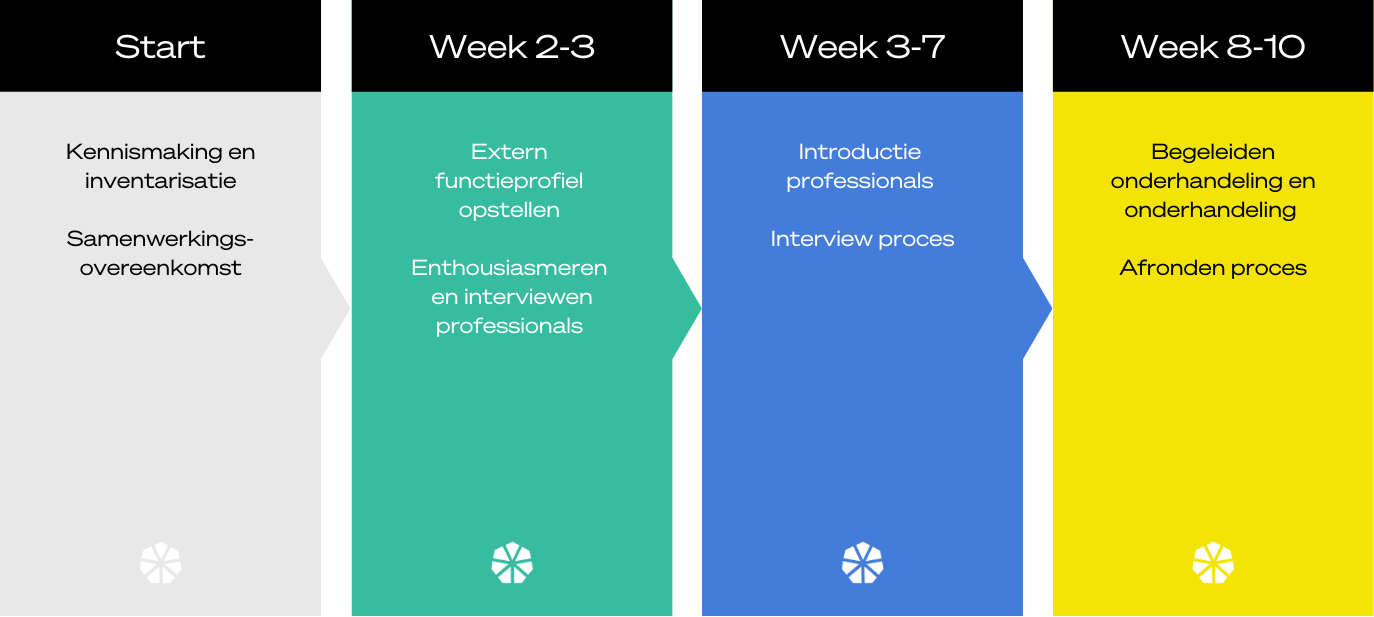
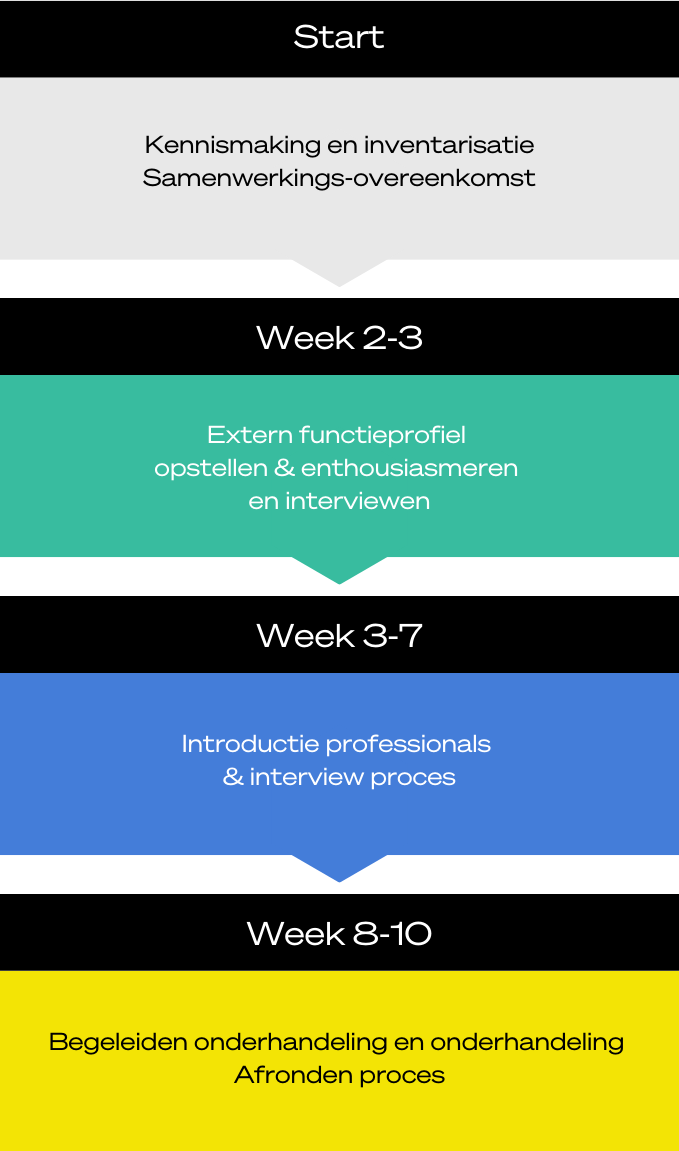
At LEMON, we work with a tight but flexible timeline. We start with an in-depth intake and profiling session, so we know exactly who we are looking for. Then we go to market: after approximately two weeks, you can expect to see the first suitable candidates. We then guide the interview process and make sure momentum is maintained. In the final phase — around week 8 to 10 — we steer the negotiation and ensure a smooth landing. This keeps the process sharp, fast, and pleasant for everyone involved.
In a fast-moving market where candidates have multiple options, small missteps can have significant consequences. In practice, we see the following mistakes most frequently:
At LEMON, we help you avoid these pitfalls. We guide not only the sourcing, but also the structure and pace of your process, and advise you on your offer and candidate experience.
In a competitive market, candidate experience is a differentiating factor, arguably the most decisive one. High potentials form impressions of your organisation before the first conversation, and even more intensely throughout the process. How you communicate, how quickly you respond, how you conduct the interview, and how you make an offer: all of these are signals about what it will be like to work with you.
Organisations that stand out tend to do so in three areas:
We also deliberately advise on the final stage of the process: the offer. The era of deliberately low opening offers is over. High potentials are sensitive to how an offer feels. A strong, serious offer from the outset reinforces the positive impression you have built throughout the process, and increases the likelihood of a yes.
No — and in many cases it is actually counterproductive. The so-called ‘purple squirrel’ rarely exists: someone who ticks every box, has the exact background, accepts precisely the requested salary, and is intrinsically motivated for your role. Anyone who keeps searching for that candidate loses valuable time and misses real opportunities.
What works better is selecting on potential and drive, with an eye for what someone can become within your organisation. Ask yourself: which aspects are absolutely essential for the role, and where can someone still develop? Organisations that focus on this demonstrably make better hires, because a candidate who sees room to grow is also motivated to deliver.
On top of that: someone who has done everything already is rarely adaptable enough for a new environment. High potentials who still have their best years ahead of them bring energy, curiosity, and engagement that is hard to match.
At LEMON, we help you make this distinction clearly: what are the hard requirements, what are the nice-to-haves, and how do you sketch a development path that appeals to the right candidate?
Hiring a high potential is step one. You only truly retain them by investing in an environment where they can grow, be themselves, and make an impact.
Based on our experience, the following factors are most critical for retention:
Extremely important, and that importance is growing. High potentials in finance are making increasingly deliberate choices for organisations that align with who they are and what they value. They want to identify with the organisation’s purpose and values, and to feel whether there is a match in how people work, what gets celebrated, and what truly matters.
At the same time, they want to personally contribute to the organisation’s success. They don’t want to disappear into a large machine, they want to feel that their contribution genuinely makes a difference, for the team, for the business, and for the organisation’s mission.
In practice, this means culture must be an explicit part of your story in the recruitment process. Don’t only talk about the role or the salary, but also about the atmosphere in the team, the way people collaborate, the role of finance within the organisation, and the extent to which employees are heard and involved.
Organisations that can communicate about this authentically and concretely attract the right people, and keep them. Culture is not just a recruitment argument; it is the foundation of sustainable retention.
Yes, and this is an opportunity many organisations underestimate. In the Netherlands, a large group of highly educated international finance professionals is active, both from within the EU and from outside. They are highly qualified, ambitious, and often excellently suited for finance roles.
By opening your search to non-Dutch-speaking candidates, you significantly expand your talent pool. This does require some practical considerations:
At LEMON, we see that organisations open to international talent consistently find the right candidate faster. We help you assess whether and how this is feasible for your organisation.
LEMON specialises in recruiting ambitious finance professionals with 3 to 8 years of work experience, in the salary range of €70,000 to €100,000. We are not a generalist, we focus entirely on one target group and one market, and we know that market inside out.
Our approach is built on genuine connection: we actively maintain relationships with ambitious finance professionals, even outside active recruitment assignments. This means we can act quickly and precisely when you have a vacancy.
What you can expect from us:
Together with LIME and LIME Interim, we form a complete platform for finance: from executive search to interim solutions and talent management advice. This means you can always turn to us, regardless of the phase or urgency of your need.
Earlier than you think. Many organisations only bring in a specialist when the urgency is already high, when someone has already left, or when the workload on the team has already become too great. That is understandable, but it is not optimal.
Since the average recruitment process takes 8 to 9 weeks, followed by a notice period of 1 to 2 months, starting on time is essential. The earlier we begin, the more room there is for a thorough and high-quality process.
But even outside of active vacancies, it can be valuable to have a conversation with us. We are happy to think along with you about your team structure, the composition of your finance department, and which profiles you will need in the short and long term. That way, we are well-prepared together when a role does become available.
Feel free to reach out via info@lemonsearch.nl or www.lemonsearch.nl.